Tuesday, June 28, 2011

Typisch Goethe Institut

The phrase "typisch Goethe Institut" ("typical Goethe Institute") has come to mean, among some of the Wash U students here, any situation at or involving the Goethe Institut that is slightly awkward, slightly confusing, and generally involving some level of miscommunication (from slight misunderstanding to complete inability to carry on a conversation).  This past weekend the Institut sponsored a trip to Leipzig, an East German city between south of Berlin and north of Dresden.  For only 60 euro (including transportation, housing, breakfast, and museum tickets), it seemed like a great idea.  And it was.  It was just also typisch Goethe Institut.

We took the train to Leipzig early Saturday morning.  When we arrived around noon, people were handing out free apples in boxes outside the train station, and our group of twenty-six assorted foreigners  was surrounded by an equally sized group in full costume heading to what appeared to be an animé convention.  We seemed off to a good start.

Anna, Joel, and I with our boxed apples.

We never did figure out what they were for.

We all took the tram over to our hostel to check in and drop off our bags.  The hostel was in quite possibly the ugliest part of Leipzig, and there was some mysterious difficulty with the check-in process that caused it to take approximately twenty minutes, while the 26 of us waited shoulder-to-shoulder in the small lobby.  Eventually, however, we got our rooms, made our beds (the pillows were actually just smaller versions of the blankets, which was amusing), and headed back into the Innenstadt (city center).

Across the street from our hostel.  Schön!

Right down the block.

We spent the morning wandering rather aimlessly around the city as an unwieldily large group.  It was, however, still quite enjoyable.  The city center of Leipzig is (actually) quite beautiful, as it for the most part escaped the WWII bombs that destroyed many other historic cities in East Germany (such as Berlin and Dresden).

Anna, Bart, and I in the Innenstadt.

Fire Juggler

Bart, Anna, and I re-enacting a scene from Faust.

Ceiling of the church where Bach is buried.

The man himself.

The Goethe Institut group with Goethe.

Jewish memorial in Leipzig.
"On November 9, 1938, the great Jewish synagogue of Leipzig
was destroyed by the arson of the fascist hordes.  Never forget it."

After the big group split up later in the day, some of us ran into a series of German something-along-the-lines-of-bachelor-parties.  Apparently it's a tradition in Germany to dress the bride and groom up and send them off separately with groups of their friends to embarrass themselves and try to sell cheap beer (or something along those lines) to raise money for the reception party.  They reminded me a lot of Italian graduation celebrations, actually.

Approach of the bachelor party.

We contributed a euro to the cause and got a great photo withe the groom (etc).

After a bit more walking around, we manged to find a restaurant with enough available seating to handle our (smaller but still) large group.  There was nothing vegetarian on the menu, but after a brief conversation auf Deutsch, Anna and I managed to convince our perplexed waiter to give us one of the pasta dishes without chicken.  I never miss Italy more than I do during meal times.  Better than the food, however, were the drinks.  I tried Gose, a sour beer that is a specialty of Leipzig.  The first one I tried was plain, but the Germans have a passion for mixing drinks (a là young children at a McDonald's soda fountain), so over the course of the rest of the trip I tried Gose mit Kirsche (Gose with cherry syrup added) and Gose mit Waldmeister.  I am still not entirely sure what Waldmeister is, and when I asked our waitress she was also at a complete loss for explanatory words.  The most I can tell you is that it is green and tastes good in Gose.

Don't worry, one was Anna's.

That night several of us young ones (the majority of the people from the Goethe Institut on the trip had at least a decade on me) went out to a bar for a bit.  We decided to head back to the hostel around 1am, only to find that the trams were no longer running.  Crisis averted, however, when we were able to find a taxi large enough to accommodate six people.

The next day, the six of us who had gone out together the night before (Anna, Bart, Joel, and I from Wash U, Claudia from Spain, and Pablo from Mexico) decided to split of from the big group and do some exploring on our own.  First we went to the Stasi (Ministerum für Staatssicherheit/Ministry of State Security a.k.a. the post-war East German thought police) Museum located in der Runden Ecke (the Round Corner), which was where the former Stasi headquarters in Leipzig were located.  The material was fascinating, but the museum was not very well curated, which made the visit less enjoyable and educational than it could have been.  Aside from the fact that the exhibits looked more like a middle school class project than a historical museum covering one of the most repressive secret police agencies in the world and the city's peaceful resistance movement in 1989 that eventually led to the fall of the Berlin wall (the headings were all written with Sharpie on torn corrugated cardboard), a lot of the primary source material on display was clearly not being well-cared for (archival techniques do not include tacking original documents to cork-boards without anything between them and the public).  The lay-out was also confusing, with no clear flow from one exhibit to the next.  Furthermore, our particular group of assorted foreigners struggled with the fact that most of the material in the museum was written, and all of it was written only in German.  There was a paper guide in English that summarized the information from each exhibit, but it cost fifty cents and a lot of detail was lost.  We read as much of the German as we could, but by the end of the hour or so we spent there all of us were mentally burned-out from the effort and still had the lingering feeling that we had missed a lot.  Anyhow, I would recommend a trip to this museum only if one has the ability to read German relatively well.  I would, however, that everyone take a moment to at least read the Wikipedia article about the Stasi.  The amount of power they had and the way in which it was used is absolutely chilling.

After the museum, the six of us found a restaurant by the main square and lingered over lunch for almost two hours, chatting and drinking Gose.  When we finally moved on, we took the tram a little way out of the city to the Völkerschlachtdenkmal (Memorial to the Battle of the Nations), which commemorates Napoleon's defeat at Leipzig in 1813.  It reminded me of nothing more strongly than a 90s computer game interpretation of a Mayan temple.

Where in the world is Carmen San Diego? (Anna, Pablo, and I)

The whole group: me, Bart, Claudia, Pablo, Anna, and Joel


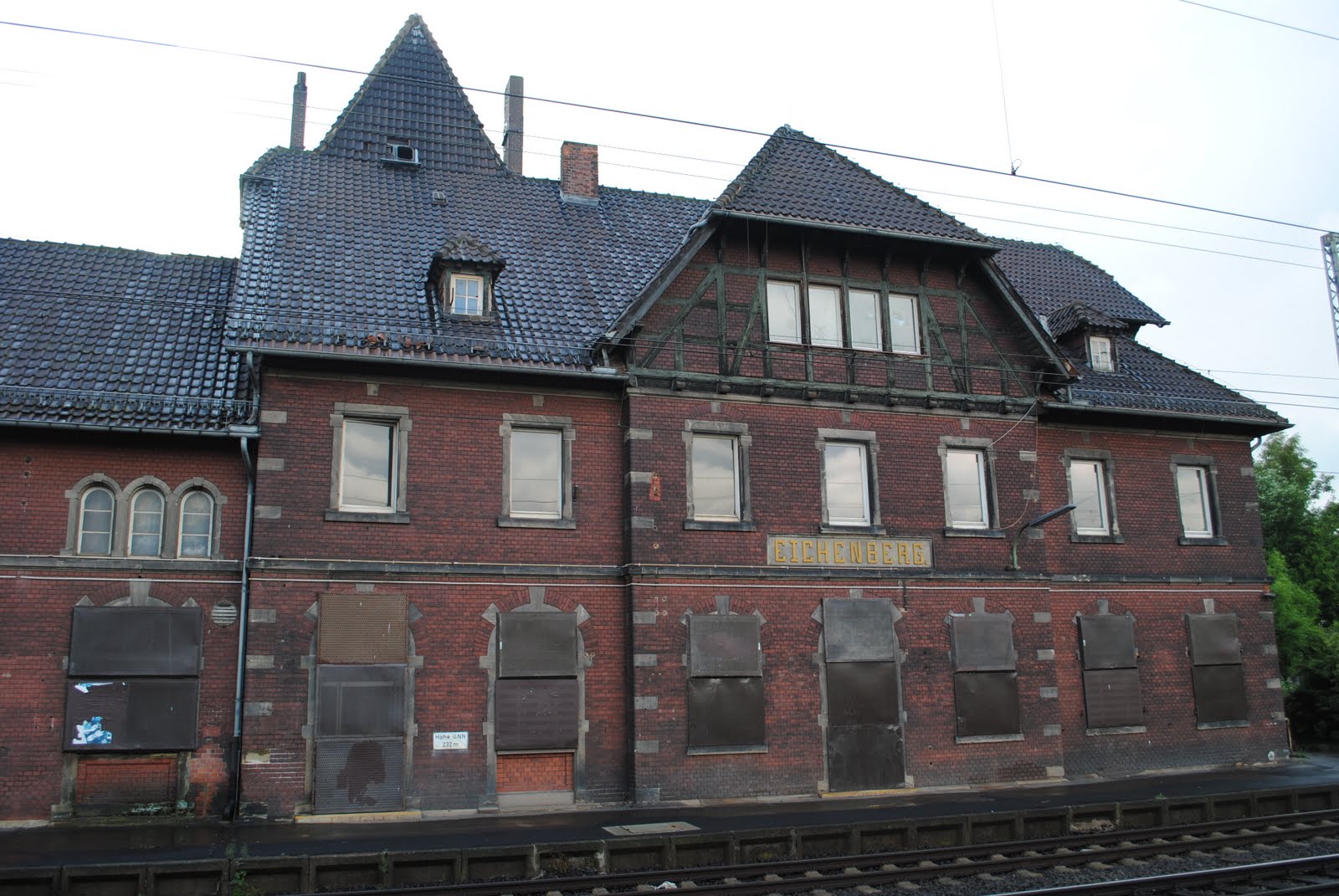
We met up with the rest of the Goethe Institut group at the train station, and began the long journey back to Göttingen.  It was a long journey in part because we were traveling from Eastern Germany to Central Germany, in part because we were all exhausted, and in part because there was a train strike that day and we ended up being stranded in Eichenberg for over an hour.  There is nothing in Eichenberg.  Quite literally nothing.  There are the train platforms, there is a massive building that looks like it should contain a train station but for some reason does not, there is a bridge, and that is all.  We were all cold and tired and, by this point, miserable, so we entertained ourselves by coming up with a rather detailed horror movie plot starring us and involving three-legged "tripod" ninjas and being stranded in Eichenberg.  By the time the train finally arrived, we had managed to sort out not only the general outline of the story, but also how and when each our characters would die.  Uplifting, no?

The entirety of Eichenberg.

Eichenberg as seen from above.

The horror movie cast: Reed, Pablo, Anna, Claudia, Joel, and I.

Eventually we all made it back to Göttingen (miraculously all still in one piece) and walked back home to the Goethe Institut.  It was then that I discovered that my roommate had, while I was away, removed her mattress, bedding, and a suitcase full of clothes from our room.  I am still not exactly sure what her motivation is, but since I returned from Leipzig almost a week ago, she has brought the mattress back and slept in our room only one night.  Which is fine with me, because I now, for the most part, have a single room.  Not too bad a deal, especially considering that we were barely on speaking terms to begin with.

Anyway, now that I have adjusted to the pace of life in Germany, in Göttingen, and at the Goethe Institut, I am starting to feel very much at home here and am very much looking forward to the upcoming weeks.

Friday, June 17, 2011

Überraschungen und Kulturschock

Surprises and culture shock.  These have been the themes of meine erste zwei Wochen in Deutschland (my first two weeks in Germany). 

To begin at the beginning (although I'm starting to realize that there is no such thing as a true beginning or end; things just flow into one another), I should explain a little bit more about the Goethe Institut.  There are twelve Wash U students students studying here, but we are still very much in the minority.  People come from all over the world to study German intensively at the Goethe Institut.  For example, the class in which I began, B22, had fourteen students and eight different nationalities represented (US, Russia, Holland, Taiwan, Saudi Arabia, France, and Costa Rica).  The class to which I was, rather mysteriously, moved after two days, the more advanced B23, has twelve students of nine different nationalities (US, Sweden, Guatemala, Argentina, Libya, Syria, Cyprus, Japan, and Taiwan).  Studying German in such an international environment is a very unique experience, and very much forces you not to rely on English under any circumstances (English can be a bad-habit short-cut to explaining a difficult concept or bypassing a forgotten vocabulary word, and goes relatively unnoticed in a classroom full of native English speakers).  However, in the beginning this international group with very little in common culturally did little to assuage my sense of culture shock and isolation.

The turning point came the first night I went out in Göttingen.  A few of the Americans left the Institut to check out a few bars in the area, with no especial success.  However, on the way back we ran into a group of Erasmus (European exchange) students in a park, and began talking to them.  As it happened, two of them were from Italy (Sicilia and outside of Roma, respectively), on a semester exchange from l'Università di Perugia.  I spent quite a bit of time speaking with Giulio and Emanuale in Italian, which assuaged a sort of homesickness I didn't even know I had.  It was then that I truly realized how attached to Italy I had become, because, as my parents can attest to, I had never previously experienced any sort of prolonged homesickness.  At the end of the evening, Giulio asked if I would be willing to meet up regularly and practice my Italian and his English together.  I hope it works out, because that would be a perfect way to keep up my Italian while intensively studying German in Germany. 

After meeting the Italians and realizing that my Italian language abilities had not been rendered entirely useless and/or obsolete when I left Italy, I was ready for my next German adventure: der Supermarkt (the grocery store).  Here's a small taste of what we faced:

Yes, that is velveteen wrapping the Wild Africa Cream.

That would be the jarred hot dog section.  A whole three shelves.

Joe was excited about the Boogie Party.

So was Spencer.

Other culinary wonders included the complete-cheeseburger-in-a-box, the corndog-in-a-wrapper-like-a-slim-jim, and an entire five-shelf section containing only ketchup.  Every time I go grocery shopping, I discover new wonders.  Boogie Party, in case you were wondering, is basically fizzy apple juice.  Robby Bubble is another such fizzy juice drink, and comes in three flavours: grape, cherry, and Jungle Party.  What is Jungle Party, you might ask?  I would love if I could answer that.  Unfortunately, Robby Bubble Jungle Party remains, for now at least, a mystery.  Fashion in Germany is another source of mystery for me, especially having come straight from Italy (albeit the supposedly "least fashionable city in Italy").  Here's one of our favourites:


We had a game we would sometimes play in Bologna, in which we would count the number of American flags we saw in a day in Bologna.  It was really quite shocking.  I've seen more American flags this past semester in Europe than I had seen in at least a year before that.  Gotta love those stars and stripes, I guess. 

Anyway, having successfully navigated a German grocery store (an even more impressive feat, considering my vegetarian status and the current E. coli scare and the subsequent lack of fresh vegetables), I decided that I might as well go all out and try to have a real German friend (especially considering how awkward most of the cross-cultural, linguistically-stunted conversations at the Goethe Institut are...my new Wash U friend Anna and I went out one night with a Polish guy and a man from Moldova, neither of whom had a firm grasp of German or English.  We spent a lot of time staring across the table at each other).  So, I called Immo and asked if Anna and I could come visit him in Kassel that weekend.  Fortunately, Immo was still excited about the idea of meeting up again, so we agreed that we would come the Monday afternoon of our long weekend (long in honour of Pfingsten, a.k.a. Pentecost).

That Monday, Anna and I made it to the train station on time and managed to board our train without too much difficulty or stress (this was rather remarkable, considering both of our incredibly poor senses of direction and our utter lack of map).  Unfortunately, we didn't realize that we were on the wrong half of our train, and consequently ended up in Eschwege, a tiny town in the middle of nowhere, rather than Kassel.  Oops.

After sitting in the abandoned train car (for we had reached the end of the line) for approximately twenty minutes, we decided to ask someone where we were. 

"Entschuldigung, wo sind wir?"  "Eschwege."  "Oh, ok, danke schön!"

Fortunately, someone overheard that little encounter, watched us sit right back down, and took pity on the poor, confused foreigners.  This man led us out of the train, gave us a train schedule, led us over to talk to the conductor about the fastest way to get to Kassel, and proceeded to sit with us for the entirety of the ride and lecture us about how to use the Deutsche Bahn (German train system).  So, it only ended up taking three hours for us to make what should have been an hour-long journey.  Immo bore with us, however, and met us at the train station with his dog, Lana.  He also laughed at us quite a bit.  I suppose what we did would seem like a very amateur mistake to someone used to the Bahn. 

In Kassel, we explored a park with a view overlooking the city with Immo as our tour guide, and happened to be just in time to see the weekly running of the water down the stone steps of the hill.  Then we enjoyed some crepes, a few beers, and music on one of the main streets in Kassel, which was celebrating that day with a Stadtfest (city festival).  One of my favourite moments was when Anna and I were trying to figure out how to say hedgehog in German (we had seen a hedgehog a few days earlier in Göttingen, and were trying to tell Immo about the experience).  Once he realized we were talking about der Igel, Immo asked us what it was called in English.  When we told him, he looked slightly confused.  Then he made a fin motion over his head.  "Shark?"  We nodded.  Sharks have fins.  Then he made a tipping motion by his forehead.  "Hat?"  We nodded.  Hats go on heads.  Then, "Hat-shark?"  No, not a hat-shark.  A hedgehog.  As in bush-pig. 

I always feel better about all of my linguistic failures when I realize that I'm not alone.

Anyway, after several hours of beer and chatting, we went our separate ways, Immo to a barbecue and Anna and I back to Göttingen.  However, before we went, Immo invited Anna and I to his birthday camping trip the first weekend in July, and he said that if he can he might come visit us in Göttingen.  This also made me feel like I am starting to find a place in Germany, and reassured me that it is possible to make friends almost anywhere.

The only other notable instances over the past week (since our schedule at the Goethe Institut is the same every day) have been the surprise fireworks and the crazy man outside our door.  As for the fireworks, we still have no explanation.  Joe, Anna, and I were sitting in Anna's room when we started hearing popping sounds outside the window.  Sure enough, there were fireworks, so we ran up onto the tower balcony to see them.  We still have no idea why they were set off.  As for the crazy man outside our door, it is exactly as it sounds.  Anna, Joe, and I were coming back from town when we encountered a stranger sitting on the steps of the Goethe Institut.  He told us, among other things, in a strange mix of German and English, that he was a Paraguayan kick-boxer ("the fastest in the world.  All the other ones want to be fast like me") who had written a story called Schwip-Schwap (which is, by the way, the name of a German soda) that J.K. Rowling stole to write Harry Potter.  Apparently she is more famous now ("richer than the queen!"), but he writes with more soul.  He also recited a little poem for us, that transitioned seamlessly back into his rather dubious life story:

"If you have the time,
I have a little rhyme.
I am cheese,
I am onion.
I am life,
I am death.
I am funny,
I am hopeless..."

At which point he forgot his recitation entirely and told us his age instead ("I am 44 years old...").

We stayed outside int he rain and listened to him for a long while (mostly because he was between us and the door and we didn't want to let him inside), but eventually one of the men who works at the Goethe Institut came outside and asked him who he was here to see and the three of us ran around and let ourselves in through the back door.  Normally, however, life in Göttingen tends a bit more toward the mundane (albeit a very unusual sort of mundanity).

The routine will be broken this weekend, however, as Anna and Bart and I are off to Leipzig with a group from the Institut.  Viel Spaß (a lot of fun)...we hope!

Die Abenteuer in Deutschland beginnen!

...und so beginnt das deutsche Abenteuer (and so begins the German adventure)!

I am writing now from my room in the Goethe Institut in Göttingen, a small town in central Germany (Niedersachsen/ Lower Saxony, to be exact).  How did I get here?  By train!  My last post ended with Rob and I sitting in the Bologna train station waiting for our hour-delayed trains to arrive to go our separate ways.  Eventually, our trains did arrive, and after a brief goodbye I struck off on my own.  I found my seat on the train without difficulty (and even managed to avoid upsetting too many people in the small corridor with my large quantity of luggage on the way).  Almost immediately after I sat down, the German man seated across from me began voicing his complaints (auf Englisch).


"I cannot believe these Italian trains.  Why must we have such a long delay?  When we left Rome we were only five minutes late, which in most parts of the world is considered on time."


And so on.  I got the sense that five minutes late was not considered on time in his personal part of the world.  However, after this small rant he became quite friendly, and moved into a nearby empty seat to allow me some more leg-room for the upcoming seven and a half hour overnight journey.  I actually managed to sleep surprisingly well, considering I was crammed into the corner of a six-seat train compartment.  It turned out to be fortunate that I had the window seat, however, because the sunrise over the mountains in southern Germany was breathtakingly beautiful.  The entire train journey was worth it for that sleepy moment.  Furthermore, we actually made it to München (Munich) three minutes early, much to the delight of my German compartment-mate.  I was also pleased, because it meant I was able to walk straight onto the next train to Göttingen.


After a bit of confusion in which I tried (unsuccessfully) to find what looked like second class before realizing rather sheepishly that I was, in fact, already in second class (my confusion stemmed from the fact that this German second class car was much nicer than many Italian first class cars), I settled into another window seat, curious what I would find at the end of this five-hour train ride. 


Turns out I didn't have to wait that long.


A few minutes after I had boarded the train, a guy about my age with a giant backpack (even bigger than mine, which is saying something) got on with his dog and settled into the seats across the aisle from where I was sitting.  An hour or so into the train ride he asked me where I was going (presumably because my broken, accented response to a train employee earlier had indicated I was far from German, and there is very little to attract foreigners to central Germany.  The most map-worthy city is Kassel.  Have you heard of it?  Neither had I).  This began a conversation that alternated between German and English and lasted for the rest of the trip (read: we made slow small-talk in German until it became painfully obvious that 1. I am not very interesting in German yet and 2. his English was almost as good as mine).  His name was Immo and he was on his way back from a two-month trip during which he had walked from Greece to Serbia with his dog, Lana.  Before he got off in Kassel, where he had been studying at the university, he gave me his phone number and told me to come visit sometime.


This was a nice confidence booster that held me together for the last twenty minutes of the train ride and through the taxi ride to the Goethe Institut, which is slightly outside of town.  Unfortunately, emotion and exhaustion collided during my oral placement test, which took place mere minutes after my arrival at the Institut (even before I was given my room keys).  Since for the majority of the placement test I was focusing more on trying not to speak Italian or burst into tears, I had little hope of being placed into a more advanced section.  Imagine my surprise then, when the results were posted and I was listed in the B22 section (out of a possible A1, A2, B11, B12, B21, B22, B23, C1, and C2).  Not bad, considering the placement test scenario and the fact that I hadn't spoken German (other than that night in Belgium) for approximately six months.


That night was spent battling culture shock and getting to know the other Wash U students in Göttingen.  There are twelve of us here, but I hadn't known anyone well before arriving.  Moving from Italy to Germany was quite a shock on many levels, from the language to the food to the pace of life to the size of the town.  I initially felt quite isolated, having no one to commiserate with about my culture shock, being surrounded by a group who already knew each other reasonably well, and having no internet to communicate with old friends and family (not having a debit card a.k.a. access to money didn't help either).  My culture-shock induced depressive mood was further compounded by the cold and heavy rain that was a constant throughout my first days at the Institut, and the fact that I didn't speak with my roommate for the entire first week.  I still don't think we're ever destined to be great friends (read: friends at all), but at least I know her name now.

Here are some photos of Göttingen to provide a mental picture of where I am now living:


Das Goethe Institut: my room is the triple window.


Chandelier in the Great Hall.

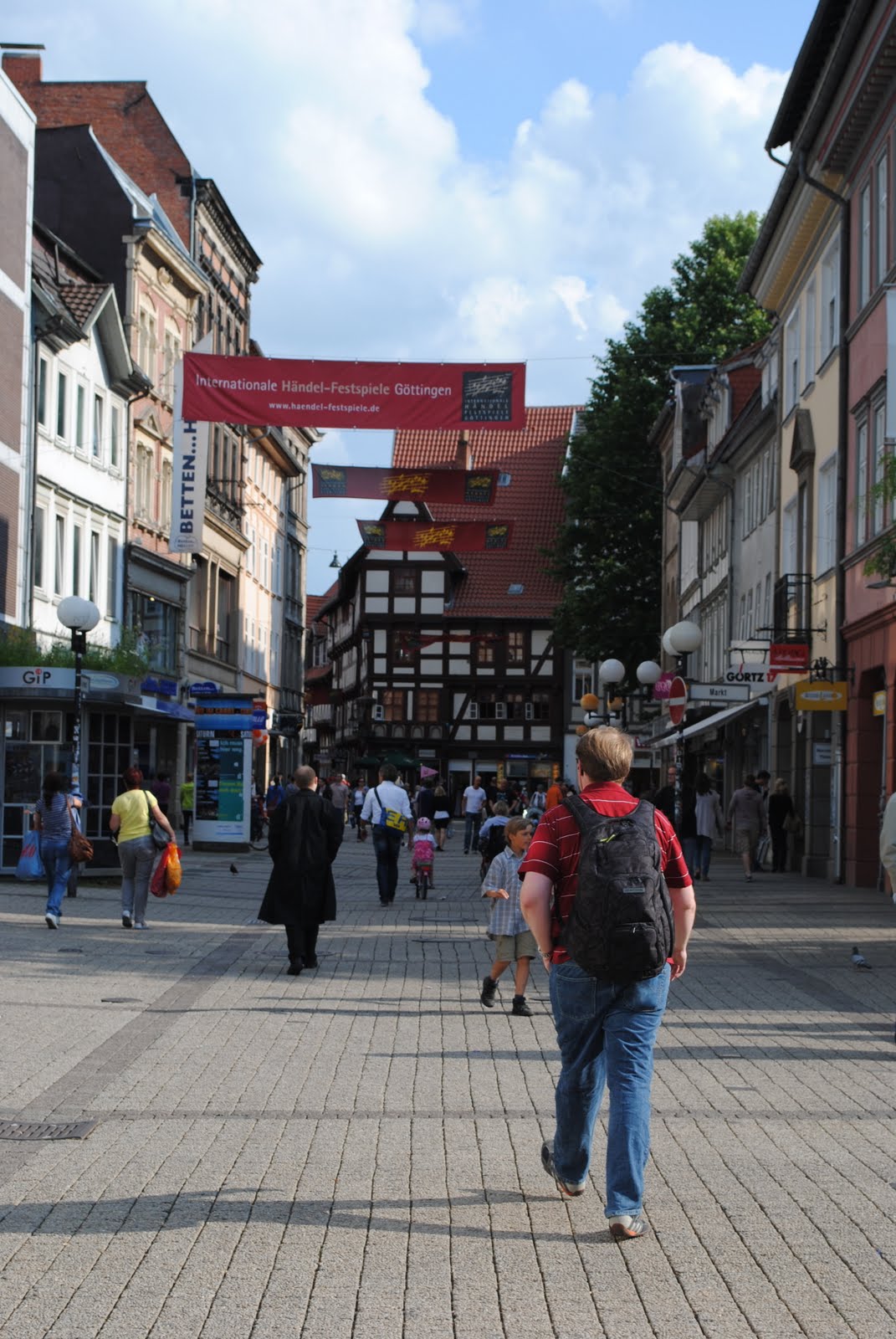
Downtown Göttingen.

Die Kirche.

Die Gänseliesel (goose girl).

Göttingen is far from Berlin.

Der blaue Turm (the blue tower).

The view from my window.  Not bad, eh?


The more time I spend in Göttingen, the more I am beginning to feel at home here and at the Goethe Institut.

Tuesday, June 14, 2011

Gli ultimi giorni a Bologna

Almost immediately after my return from Belgium, my friend Vanessa came to Bologna (bringing with her a much-appreciated replacement camera...as well as my Belgium photos came out, considering that they were taken with an iPhone, I would still much prefer a real camera).  I spent a summer in Castelraimondo, Italy with Vanessa two years ago, so we went back to Le Marche to visit for a weekend before Vanessa continued on to Sanremo for her summer job working in English language summer camps and I returned to Bologna for my last week.

Before we left for Castelraimondo, however, I had an exam to make it through.  More precisely, I had the written half of my Fenomenologia exam.  It was fairly impossible.  The course had been an art history survey of the twentieth century, from Expressionism to Post-modernism.  Our book had likewise covered twentieth century art.  With that in mind, here is a sample question from the exam: "Here is a title of a work from the 15th century.  Who was the artist?"  And so on.  No one had any idea what to do, so most of the class compared papers and whispered to each other while the professor looked blithely on from his seat at the front of the room.  I turned in my exam with at least a third of it left blank, and most of what I had filled in based on previous knowledge (i.e. from AP Art History in high school) rather than anything I had learned in the course. It was an overall mystifying experience, and I reminded myself that all I needed to do was pass.

I was able to distract myself from dwelling on this utterly impossible exam fairly easily, however, considering that I went nearly straight from the exam room to the train station, stopping at home only long enough to eat a quick lunch and throw some clothes in a backpack.  The train ride to Castelraimondo was long and full of changes, but I managed to get quite a bit of reading done on the way.  I ended up getting off in San Severino (another small town right near Castelraimondo), where I met up with Vanessa, Iva (one of my Wash U Italian professors who spends the summer teaching in Italy), Gugu (another of my professors from two summers ago), and Gerta (one of our friends from Castelraimondo).  We all ate dinner with Gugu's family in San Severino before heading back to Castelraimondo to sleep.  Vanessa and I stayed at the same villa we had lived in two summers ago, and I ended up sleeping in the very same bed.

The next day was beautiful weather, so we spent it walking around downtown Castelraimondo, buying some fresh produce at the vegetable market, cooking a fantastically huge lunch, and lying outside by the pool.  Giorgia (the owner of the villa and another friend from two summers ago) also came over and I had the chance to meet Nicola, her two-month-old son.  So adorable!


The entirety of Castelraimondo.

Vanessa and I outside the villa.


Our feast...I mean, lunch.


La piscina e la vista.  Che bella!

Il piccolo Nicola.  Così carino!


That night Vanessa and I enjoyed a small dinner and quite a few YouTube videos with Iva and Gugu.  The next morning, after breakfast and another quiet morning at the villa, I headed back to the train station to try to find a train to Ancona.  Ancona is the largest city in Le Marche (in the sense that Portland is the largest city in Maine...it still isn't very big), and all of the trains from Castelraimondo either go through there or through Civitianova Marche, another nearby town.  The number of times I had seen the Ancona train station, combined with the number of friends (including both of my roommates) I had met in Bologna from Ancona, meant that a visit there was a must before leaving Italy.


After some trouble with the trains either not existing or not running on Saturday, I finally made it to the Ancona train station, where my friend Luca was waiting to pick me up.  We drove around for a bit on a combined city-tour/errand run with Benny, one of my roommates.  Once we had completed our errands, we drove out to the beach at Portonovo and sat looking at the waves and chatting for a while.  Eventually we had to go back and drop Benny off, which was sad because it meant saying my first final goodbye (she was about to take a trip to London and wouldn't return until after I had left).


The goodbye was rendered more bearable by the hellos said right afterward, as Luca and I returned to the train station to pick up Marie, Lubín, and Maddy, who were coming in from Bologna.  The five of us went back to Portonovo for dinner, where we ate a fantastic (if somewhat pricey) seafood meal on the beach.  It was absolutely delicious and entirely worth it, because it gave us a chance to sample many of the regional specialties of Ancona, such as spaghetti with red sauce and mussels.  Yum!  The only downside was that Lubín doesn't eat seafood or drink wine, so he spent most of the meal looking like someone's unruly five-year-old sitting at the head of the table, drinking water, and eating all of our bread.


After dinner we went back to Luca's apartment, where we met his parents and dropped off all of our bags in the guest apartment in the basement.  We spent the evening sitting by the water several minutes from Luca's house and watching the crowd come and go from a nearby club.


Not a bad view, eh?


We spent that night on fold-out couches in Luca's basement, and woke up early much later than we intended to go back to the beach at Portonovo for some sunbathing and swimming (and excellent people-watching...my personal favorite was the man in a white speedo and a cowboy hat).  First we ate an enormous breakfast courtesy of Luca's mother, who also made us sandwiches to take with us for a picnic on the beach.


Portonovo itself was gorgeous, and the weather was perfect (sunny and clear without being oppressively hot).  Our friend Nicola met up with us at the beach, and he, Marie, Luca, and I actually went swimming, which was certainly a novelty for me if not for the others (the Atlantic coast of Maine is far to frigid to submerge yourself in for more than about thirty seconds).

The beach at Portonovo.  Note the Italian flag.

Nicola and I, looking very orange for some reason.

Italians on a beach.  Note the aforementioned speedo/cowboy hat combo.

After a few hours at the beach, Luca, Marie, Lubín, Maddy, and I said goodbye to Nicola (for what we thought might be the final time, and was for everyone but me) and headed to a nearby vineyard for some wine tasting.  There was a deal that weekend in Le Marche where you paid five euro and got a wine glass, a little pouch to put it in and hang around your neck, and unlimited wine and cheese (and jam and bread) tasting at all of the wineries in the area.  Not a bad deal!  We made it to three different wineries, including a tour at the first, before having to go back into town and pick up our stuff from Luca's house before catching the train back to Bologna.
 
Lubín and Luca looking over the vineyards.

Modeling our mysteriously necessary wine glass pouches.

The entire crew over Ancona: me, Luca, Maddy, Marie, and Lubín.

We got back to Bologna around midnight, and I had the oral part of my Fenomenologia exam at 8am the next morning.  It was another ridiculous and strange experience.  After first being told to sit in on someone else's exam (which seemed to be a book report for an entirely different course), the professor had Jenna (the other American in the class) and I take our exams together.  It was another strange and mysterious experience.  Here's a rough transcript of the beginning of our conversation (in English for your convenience):

Professore: What do you want to talk about?
Us: ummm...Expressionism?
Professore: Ok, talk about Expressionism.

From there we moved on to the (negligible) differences between American and European Pop Art and a list, in order, of all of the artistic movements of the nineteenth century (keep in mind that our course covered only the twentieth century).  Eventually the professor just interrupted us and asked how we would feel about a 28 (out of a possible 30).  Utterly mystifying.

My last exam, Storia della Radio e della Televisione, followed shortly after and passed without incident (it consisted of five short answer questions and one short essay).  With exams completed and only four days left in Bologna, the semester wound down quickly.  Nicola came back from Ferrara for an afternoon, so I had the chance to say a more satisfying final goodbye to him (the most final-feeling goodbye of all, as I walked him to the train station and sat on the platform with him until his train took him back to Ferrara).  The Brown group enjoyed one final dinner (almost) all together at Osteria 15 the last night that everyone was in Bologna.  I spent the evening afterward helping Marie frantically pack everything for her flight back to the United States early the next morning.

The next night I went out for two aperitivi.  The first was with Matteo, my language partner.  When he had to leave I met up with Luca, Lubín, Ceci, and Giulio, Ceci's friend from Milan who had come back to Bologna for the night to say goodbye to me.  The spitting rain contributed to the bittersweet tone, but didn't stop us from meeting up with the rest of the remaining Brown students and Italian roommates for gelato alla Sorbetteria Castiglione.  The absences were felt, but it was a fitting cap to a wonderful semester.

Luca, Jaclyn, Saerim, Simon, Lubín, Giulio, Diego, io, Loren, Fabrizio, Martina, e Rob.

The next day only Jaclyn, Rob, and I remained.  We cooked in my kitchen a final time, got gelato at Funivia a final time, and I took one final nap in my empty bedroom in my empty apartment.  Ceci and Luca came over to say goodbye to me and help me with my bags, and Ale (Rob's language partner), drove us to the train station...where we found that both of our trains (to Munich and Paris, respectively) had been delayed by an hour.  It proved to be a fortuitous coincidence, as it gave Rob and I a chance to spend a bit more time together, sitting on his giant bag on the floor of the station, before we had to split off to our separate platforms and wave goodbye to San Luca on the hill one final time.

So ends l'avventura bolognese...for now, at least.

(more than just) In Bruges

First of all, I deeply apologize for the inexcusable absence.  Now I will proceed to excuse it:  It has been an incredibly hectic last few weeks as I wrapped up my time in Italy, moved to Germany, and began adjusting to life here.  This combined with my lack of computer meant that this blog unfortunately fell by the wayside.  Another way of looking at the almost month-long absence is that I have been too busy living life to have time to write about it!  However, now that I have some time on my hands (and my new friend Joe was kind enough to lend me his computer for the afternoon), I will do my best to fill the gap and bring this blog up to sync with what is actually semi-currently happening in my life.

So, without further ado, BELGIUM!

My trip to Belgium was originally supposed to include a few days in the Netherlands as well, but thanks to unforeseen complications with train schedules and availability I ended up staying in Bologna a few more days and flying instead.  This wasn't as disappointing as it might have been because it meant that I had a travel companion rather than taking the train alone.  I also had some time to relax and gather myself together again after my first final exam and my roommate Ceci's birthday party (several of her friends came from Milan to celebrate and it turned into quite a night--full of fava beans, gelato cake, and dancing--that ended with eight people sleeping in our four-person apartment).

When my Belgian adventure finally did commence, it commenced very early in the morning.  Simon and I met outside of my apartment at 3:30 in the morning to begin our journey to the airport.  We arrived with plenty of time, but as part of Ryanair's never-ceasing quest to be as inconvenient as possible, they charged me 40 euro to check-in.  Bummer. 

Eventually we made it to Brussels Charleroi, conveniently located an hour-long bus ride outside of the city (read: half-way across Belgium).  After a series of buses and metros we arrived in the city center, where we ate waffles without further delay.  While it is true that the waffles in Belgium so delicious as to be everything you could ever want and more, this is not the case with the remainder of Belgian cuisine.  As I would learn over the course of the trip, the only things worth paying to consume in Belgium (other than the waffles) are the frites (french fries), the chocolate, and the beer.  Healthy, no?  Everything else is generally overcooked and full of ham. 

Brussels is beautiful, even if the food is a bit iffy.

But I am getting ahead of myself.  Before I learned why there is no such thing as a Belgian restaurant, I learned that our travel difficulties were far from over.  Rob met Simon and I in Brussels after mistakenly catching the wrong train from Amsterdam and arriving rather late.  This meant that by noon, when we made it to the other train station to pick up the car we had rented, Europcar had closed fifteen minutes before.  After some frantic discussion with the man at Hertz and with the knowledge that we had to be in Westvleteren by 3:00pm or our beer reservation (the one Simon had called the brewery 108 times for) would be void, we caught a taxi to the Brussels airport (the one actually in the city) to try and pick up a car from the Europcar there instead.  After what seemed like an aeon of paperwork...success!

So we struck off in our little white car across the Belgian countryside to Westvleteren and, more importantly, the brewery there where a case of the alleged best Trappist beer in the world (Westvleteren 12, which is not commercially available) was awaiting us.  We made it to the brewery without too much trouble and picked up the beer without incident (amazingly enough, considering the way the rest of the trip had been going).  After lunch and a full flight of the Westvleteren beers (the 8, the 12, and the blonde) at the brewery cafe and a nap in the grass, we got back in the car and continued on to Bruges, with Simon in the driver's seat learning stick-shift.  Yikes!

Look at all those Westies!

We got a bit lost and ended up circling Bruges for a while before realizing we had actually passed our hostel several times already.  Once we had settled in, we walked into town and found a relatively inexpensive restaurant with outdoor seating.  Unfortunately, during dinner Rob had a bit of a choking attack and scared the waitress, but in the end the worst that happened is that his salad was taken away before he had quite finished.  After dinner we took a nighttime walk around Bruges and enjoyed some more fried before spending a miserable night at the hostel full of plastic mattresses and hourly alarm clocks.

Fortunately, the next morning we managed to stumble into an adorable little tea shop for breakfast where we enjoyed some of the richest hot chocolate and waffles of our lives.  The waiter brought huge bowls of steaming milk, a little chocolate bowl full of chocolate chips, and a whisk, and you literally drop the chocolate into the milk and stir.  We were plenty hungry when we arrived, but even Rob (who usually serves as our garbage-disposal) had trouble finishing his!

There were also cookies involved.

After breakfast we continued on to the Groeningemuseum, which was a treasure trove of interesting works drawn from six centuries of Flemish and Belgian painting.  I was saddened to discover that In Bruges had lied to me (something that would occur repeatedly during our time in Bruges) and that there was nothing by Hieronymous Bosch in the museum, but that was really the only complaint I culd come up with, especially considering the 1 euro student entry fee.

The fourth member of our little group, Loren, arrived in Bruges from Amsterdam just as we finished in the museum, so we went back to the main square with him and climbed the tower (which, we were disappointed to find, was not actually the same tower as the one featured oh-so-prominently in In Bruges.  Hollywood lies.  Who knew?).  When wemade it back down to the ground we grabbed one final snack of fries from the stand at the base of the tower, sat in the square for a bit, took in the view, and got back in the car to drive to Watou, where we had a reservation at the Brouwershuis, a bed&breakfast connected (almost literally) to the St. Bernardus brewery.

The tower in the main square in Bruges.

Pride in Bruges!


A view from the car in rural Belgium.


Welcome to Watou!

Once we had checked into the B&B, been shown our (incredibly nice) rooms, and enjoyed our first free beers from the St. Bernardus refrigerator (one of the major perks of this particular B&B), we decided to take a walk through the nearby fields full of cows.  It was a wonderful pastoral moment, and definitely a big change from Bologna.

Simon, Loren, and I in front of the field across from the B&B.

Ben & Jerry's cows.

Dinner that night consisted of unreasonably delicious French onion soup and unreasonably awful macaroni and cheese (remember what I said about overcooked and full of ham?).  Once we had seen all of downtown Watou (the one street that there was), we headed back to the Brouwershuis (Dutch for "brewer's house") for cards and some more of that delicious free beer.  The four of us played a round of hearts (I won!), and then we made friends with a group of German and Flemish retirees who were drinking in the next room and also staying in the B&B.  Only one of the six of them spoke any English, and out of our group only I spoke any German, so it was a wonderful opportunity to practice my speaking and translating in a low-stress, alcohol-aided situation.  We all sat around their table and spoke in a combination of broken German (me), broken English (one of the Germans), and hand gestures (almost everyone else) for hours.  It was definitely one of the highlights of the trip.

Breakfast and showers the next morning were positively extravagant when viewed in comparison with the hostel fare and accomodations that we student-travelers were (and are) used to.  With no previous specific plan for the morning, we decided to follow Rob's suggestion and head to a beach in nearby northern France for a few hours.  So we set off, without a map or any clear idea of where we were going, and followed the signs to Dunkirk/Dunkerque.  This was a mistake.  The only good thing I can say about Dunkerque is...oh, wait.  I can't.  The place is an industrial wasteland that makes Newark look picturesque by comparison.  To top things off, we had been in France no more than fifteen minutes before we were yelled at by an impatient Frenchman (Simon stalled the car at a stoplight and, rather than waiting a few moments for us to re-start the car, this man swerved into the opposite lane, rolled down his window, and gestured at us angrily, yelling the French equivalent of "It's green, you idiots!" before speeding away.  So much for countering stereotypes). 

The only pretty part of Dunkerque/ Proof I've been to France.


What the rest of Dunkerque looked like.

After a bit of dis-spirited driving in circles and fruitless searching for the hint of a beach (rather than an industrial pier flanked by giraffe-cranes), we were taunted further by a series of banners along the side of the road advertising the many wonders of Dunkerque: Culture! Historical! Gastronomy! Sea & Shore!

It was too much for us.  We turned around and went back to Belgium.

More specifically, we drove back to Watou, where we dropped off the crate that had come with our case of beer (which we carefully re-packed into Loren's suitcase for safe transport back to Bologna) and enjoyed another lunch of Croques Monsieur (grilled cheese) at the brewery cafe.
Once we had eaten and taken another brief nap on the lawn, we hopped into the car and drove back to Bruges.  After getting a bit lost (again), we realized that Belgium (or at least Flanders) is very tiny. 

When we finally made it to our hostel in Bruges, all of us were inexplicably exhausted and passed out in our bunk beds for a few hours before fixing a little picnic dinner at the hostel (we had given up on Belgian cooking entirely by this point).  Rob still hadn't quite given up on the idea of going to a beach, so once we had washed our dishes and taken care of the travel logistics for the next day, we set off for Blankenberge, a beach town on the North Sea right outside of Bruges.  Fortunately, this little outing proved to be much more successful than Dunkerque had been, and we thoroughly enjoyed several hours of frolicking in the sand and watching the sun set over the water.

Beachy success!  Especially since it was called "Amy Beach."

Wind blowing sand over the beach.

I want one in my living room.

A fitting close to a wonderful trip to Belgium.

The next day was another one full of travel and little else.  Rob, Simon, and I woke up at 4:30am and drove back to Brussels, leaving Loren to sleep and catch a later train back to Amsterdam.  Fortunately, leaving the rental car proved to be much easier than picking it up had been, so we arrived at the Charleroi airport with plenty of time to spare.

Back in Bologna, we were in the final stretch of our five months.  Nothing remained between us and the too-near end other than exams.

Wednesday, May 18, 2011

Esami, ecc.

I have come to love Bologna again since I last wrote.  After the break-in and everything else that had preceded it (the concussion, the horrendous fight, etc), I was feeling fairly done with being in Bologna and couldn't wait to just leave.  However, a little time, a little perspective, and a little frisbee cured me of that.  Now I am looking ahead to that June 5th deadline with more than a little bit of trepidation and sadness (at least I can comfort myself with the fact that the adventure will be continuing in Germany this summer).

However, the past few weeks in Bologna have been more than beautiful weather and frisbee in the Giardini (a wonderful park right outside the city walls).  I have also been quite busy studying for (and taking) my first exams.  That's right, it's exam season!  As with everything else to do with the university here, exams have quickly become a source of confusion and stress, especially because they are the only form of evaluation and consequently the basis for my entire final grade for each class.  
My first exam was for Istituzioni di storia del cinema (History of the Institutions of Film).  Given that I had not been regularly attending lectures for most of the semester (largely due to conflicts with my teaching job and with another class), that I had not seen any of the 40 films on the syllabus, and that I still had nearly three entire books to read (in Italian!) in four days, I was quite worried.  Freaking out might actually be a more accurate description of the state of things.  So, I decided to talk to the professor and make sure that I was clear on the format of the exam so I could began to plan my studying.  Her office hours were at four o'clock on Thursday.  Great.  I decided to skip my 3-5 class to make sure I get a chance to speak with her.  Oh, wait.  There's a note on the door saying that she won't be coming until five that day.  

At this point it's too late to walk all the way across the city to where my class is and back, so I settle in for an hour (....and a half...) to do some reading while I wait.  Eventually the professor shows up and I manage to make it into her office before most of the crowd that has formed by this point.  We clarify the format of the exam.  She informs me that nothing is different for Erasmus students (Erasmus is the European exchange program--we American students aren't technically Erasmus but we get lumped in) and, in response to my question about whether there are certain sections I should focus on more than others, that I just need to know tutto (everything).  She ended the session by reassuring me a bit: "Don't worry, you don't need to be intelligent to pass this exam, you just need to read and memorize everything."  Thanks a lot.  My intelligence, and not my slow reading and difficulty memorizing in another language, really is the issue at hand.

Needless to say, I did not emerge from the meeting much comforted.  

Frantic studying ensued.  I read more pages in Italian in less time than I thought possible.  I highlighted, made flash cards, watched YouTube clips, and didn't leave my kitchen table for approximately two days (other than a quick study break to make oatmeal cookies with my roommate).

Then came the day of the exam.  I woke up earlier and made it to the building where the exam would be with plenty of time.  After more frantic skimming of the book I would need to write two essays about and my notes and flash cards, the professor finally arrived.  She then proceeded to take roll, calling out all the names for a group of about 200 gathered students as we all stood in the hallway (around 20 of these students were absent, because why, after all, would you show up to take the exam you signed up for when you can just turn up next month and try again?).  Once she had checked off all of our names, she announced that only the first 96 students would be able to take the exam at this point (10am) and that the others would have to return at 11:30.  Having no idea where my name sat in relation to all of the others, I decided to just go in and see what happened.  

What happened is that the two professors administering the exam each passed out different copies and we spent about 10 minutes sitting there while they got that sorted out.  When I finally did get my copy of the exam, I was in for a nice surprise.  Contrary to what the professor had told me several days before, the exam was different for Erasmus students!  Instead of 30 multiple choice questions relating to the 40 films and two books and two essays answering questions about a third book, I only had to answer the multiple choice questions!  Furthermore, many of these questions were exactly the same as the "sample questions" given out (with answers) the last day of class.  Facilissimo (very easy)!  I finished in about half an hour, and then spent another hour twiddling my thumbs and staring at the frescoes on the ceiling until we were finally allowed to leave.

So there it is.  One down, one and two halves to go!  

Fortunately I have something like a ten-day break before my next exam, so I can take my time studying for this next one (and spend some more time on Project Amy-tries-to-have-Italian-friends--Take 4)!

Thursday, May 5, 2011

Il FURTO!

All right, everybody be cool, this is a robbery! (cue "Misirlou," and props if you get the reference).

But actually.

A few days ago, after teaching English at Castel San Pietro, a small town outside of Bologna, I walked back into my apartment and found my bedroom door ajar.  This in and of itself is not that unusual, because the door doesn't latch very well and sometimes gusts of wind blow it open.  However, I was fairly certain that I had not left my desk drawer wide open or knocked my chair over before I left. Beginning to sense that something was wrong, I stepped into the room and found all my closet and cabinet doors open and everything in a general state of disarray.  I stood still for a moment, taking in the scene.  Then it hit me.  Where was my computer? and my camera? and my earrings?

Suddenly frantic and hoping this was some kind of nasty prank, I ran into my roommate Benedetta's room and completely startled the young boy she was in the process of tutoring.

"Are you ok? Did you notice anything unusual today? Do you still have everything?"

Tears.

By then it had begun to sink in: I had just somehow become the victim of a break-in and robbery.  Fortunately for my three roommates, mine was the only room that was entered.  A series of phone calls ensued, and before long Anna Maria, my program director, arrived with her daughter to take me to the Questura to file a claim.  By this point, everything was absolutely surreal.  I was sitting in the waiting room of a police station reading Italian picture books to a four-year-old and trying not to cry.  I felt a bit like I was in Ferris Bueller or something.  Eventually (several hours later), we were led back to a desk and un poliziotto wearing a striped t-shirt and an Armani man-purse half-heartedly took down my report.  His literacy was questionable (he misspelled my name and address after copying them from my passport, and even Anna Maria commented that he wrote like a second-grader and apparently didn't feel the need to bother with punctuation), but in the end we manged to get down the list.  I lost my computer, two cameras (my new DSLR and my older point-and-shoot), my iPod, my back-up drive, and all of my earrings and bracelets.  Once everything was written down, il poliziotto advised me not to have hope and called in the next person.

I was still very much upset and in shock by this point, so I was very happy to find when I got home that Erica (who had taken a trip from France to Italy and dropped by to spend a few days in Bologna with me), had managed to make it back to the apartment without difficulty and had even made me dinner and a cup of tea.

That night I slept at a friend's nearby apartment (Erica was a good sport about substituting a bed for a couch), since I still felt too violated to stay in my apartment, let alone my room.

So, that was one (mis)adventure that I certainly wasn't expecting to have during my months abroad, but in the grand scheme of things it could have been much worse.  At least no one was harmed, at least my passport wasn't taken, at least none of my roommate's things were touched, and so on.  I also got a chance to appreciate the incredible safety net provided by the Brown program.  Anna Maria and Lilia and Dr. Martinez in the office were incredible, dropping everything to take me to the police station, calling me repeatedly to check up for several days afterwards, having the locks in the apartment changed the same night, and so on.  My friends from the program were also wonderful, continuing, as always, to be champs.  Between the concussion earlier in the week and the break-in a few days ago, their ability to  care for me has seriously been put to the test, and they have all come through in a very major way.  The one upside to this horrible situations is that it has really put into perspective how lucky I am.

Anyway, updates will probably not be as frequent or as full of photos as they have been in the past, but I will do my best to keep caught up!